
Haz clic aquí para leer en español
Written by Fidgit
The joy in this walk began to flicker somewhere around middle Bolivia. Extended illness combined with exposure to pervasive poverty and all that goes with it: hopelessness, polio, people dying of diarrhea, cruelty, the list is long. People stare unabashedly, even a greeting in their native tongues would elicit no response. Laughter was harsh and the sense of “otherness” hung like a lead curtain between us and the locals. This, more than most things, weighed heavy for me.
Entering the Cusco District which thrives primarily off of tourism, we were largely regarded as a cash cow. I watched a shop owner smile at my face as she wiped the price off a bag of cereal and quoted me a higher price. When I could initiate conversation, within 3 questions they asked how much money we made and commented on American wealth. It was tiring to confront that perception repeatedly. It was frustrating to be lumped into the category of “tourists” or being “on holiday” when weary from walking.
Then came the behemoths. A section of Andes south and west of Machu Picchu which meant climbing in jungle climates straight up and down dozens upon dozens of switchbacks and thousands of feet at a go. It was more than we had reckoned for and fatigue meant we wore out quickly.
Half way up one climb Neon waited for me for lunch as we usually eat together and then check in for the day. During check in she stated that she was “tired of our negative interactions” and that as of the next town, she was done. I felt like I was being dumped at my lowest point. That I had been measured and found wanting. We walked on a few more hours and I gutted up, told her I wasn’t interested in walking with someone who didn’t want to walk with me and I would rather not wait until a convenient point to separate, I’d rather just do it now.
We divvied up gear, and I walked hard. I walked through electric storms late into the night. I walked int the belly of a gorge, scarred by a roaring river. I walked until the full moon re-emerged and hummed calmingly, peacefully, assuring me she would never leave me and that I am enough.
Emerging from the gorge the next morning and walking across the flats outside of Cachora, I was in rough shape. Physically, my feet would only shuffle, calves actively seizing, head throbbing where I’d been struck by a rock falling from a herd of cattle uphill on the last climb. When I stopped walking, I staggered as if drunk. Mentally, I was raging and feeling bad for myself.
Coming into the crop fields which surround the town, the community were out and working, harvesting potatoes. The women gathering them into their aprons, the men loading them into sacks. “I could probably pass out cold and no one would do anything,” I thought morosely, watching them from within a cloud of negativity.
Everyone was working the field together, as they do down here. No one is left to gather their crop alone. They take turns, working each field in a day, then splitting the returns. That evening, at the home of the field owner, they discuss whose land will be worked the next day.
First I passed a circle of little girls as the leader (maybe 8 years old) instructed the group to make room for the smallest. “If she wants to play with us, let her and if she wants to sit in the shade, make room,” she commanded. Amusement played at the corner of my lips.
Then I passed the adults, loading massive burlap sacks full of potatoes into the back of a small white truck.
“Do you want some chicha?” a woman said.
She wouldn’t be talking to me. I kept moving.
“Mamicita,” several voices chimed, “you look thirsty, we have chica morada.” I had run out of water some 5km back. I turned and they were all looking at me. I was caught off guard, blinking dumbly.
The dirty white tin cup everyone shared was filled from the Jerrycan tucked in the shade of the stone wall which lined the track. It was pressed into my hands. The drink was tart, gritty, and unsweetened. The lip of the cup crusted with the resin of the corn which is ground and then fermented for a day or two. I stood aside, sipping and watched as they continued the loading process.
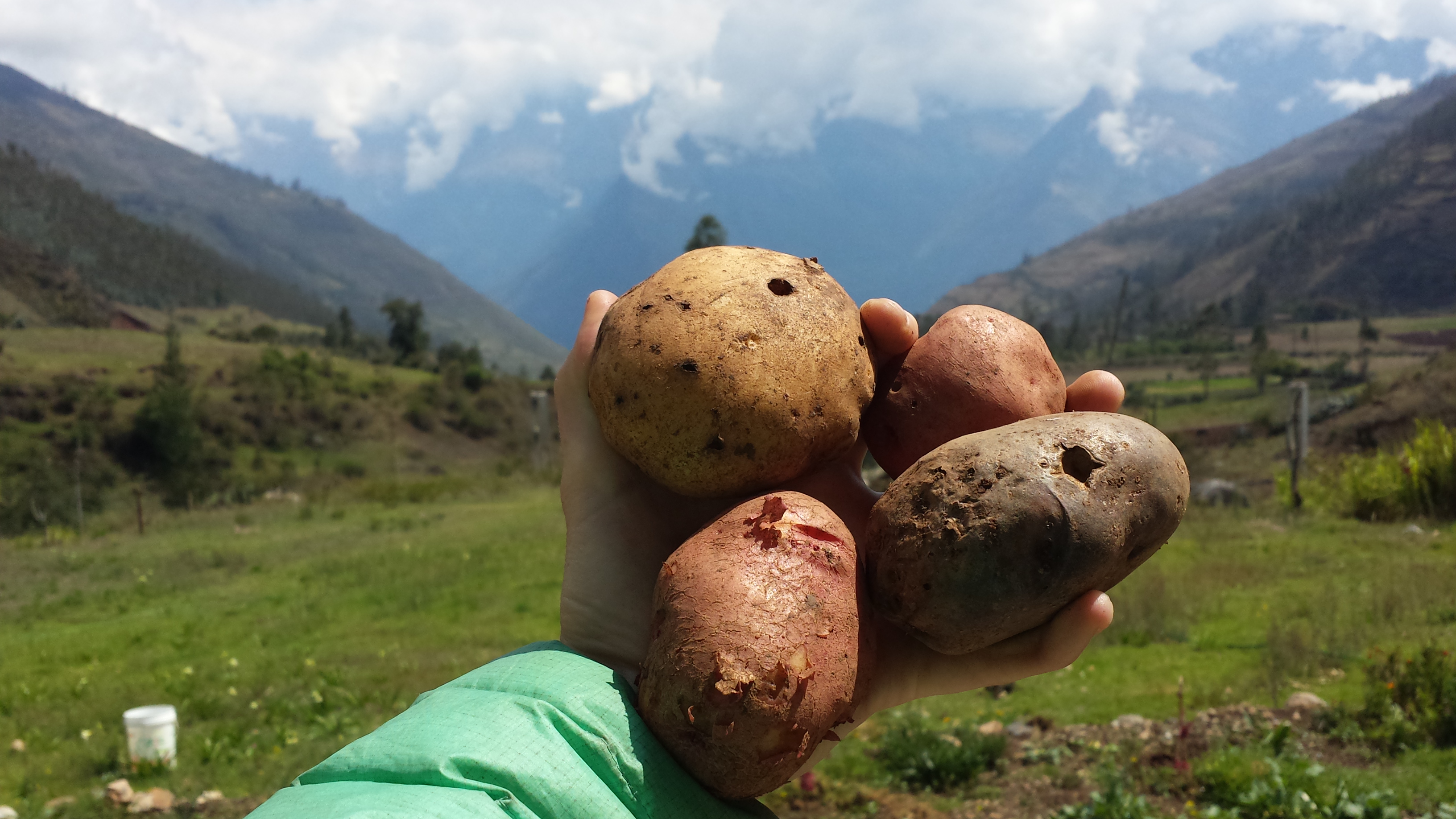
“What kind of potatoes grow here?” I asked one woman. The story of potatoes in this country is a fascinating tale unto itself. In fact, potatoes have been a point of interest ever since the island of Chiloé in Chile, where we heard of a group of women who protected heirloom lines of potatoes passed down from their mothers. Yet, even that pales in comparison to the 3,000 varieties found in Peru.
“Let me show you.” She gathered her skirts and hustled out into the field before I could tell her not to bother. That I was not worth the effort. She came back with 3 different kind: Canchán, serranita, cika and explained that different potatoes grow at different elevations.
“You must take some,” the man overseeing the loading of the truck shouted, “give the girl some potatoes.”
Skirts were gathered, and she again moved away before I could protest. I was in a daze. She came back with five pounds of potatoes, polishing them with her apron. I was delighted and dismayed. A five pound sack of potatoes is a rather cruel gift to a weary hiker. But this was one of those situations where I could not say no. Still, I worried I would be quoted a last minute price or expectations would be leveled, and I had little money.
“Can I help in the field?” I offered.
“No, you are tired, we can see you are very tired,” the lead man said, “and anyway, we have to take these into town.” He patted the bags as the men piled on top of the stacks of potato sacks; he swung into the front seat and they drove away.
I thanked Skirts and protested, “but I can’t eat five pounds of potatoes.”
For the first time, her brow furrowed. “You must share,” she looked straight into me, “you must always share.”
“Gracias,” was all I could muster, chagrined. She smiled kindly, gathered her skirts again and walked into the field, blending in among her sisters and neighbors.
I stood alone, on the dusty little back road, swill in the bottom of the tin cup, sack of potatoes at my feet. Eventually I rinsed the cup, hefted the bag over my shoulder, and trudged into town to find a place to sleep. I gave the cook at the hostel a few of the potatoes. She carefully selected four.
The next day I became the Johnny Appleseed of potatoes. As I walked around resupplying, I also carried the potatoes, offering a few to each person I passed. Neon and I convened and built toward an accord.
An ancient woman sat on a stoop. I had only a few potatoes left.
“Would you like some potatoes?” I offered.
She scowled and did not look up. “No.”
I opened the bag and held it out to her anyway. She appraised the contents, “how much?” She asked.
“Nothing,” I said. She squinted suspiciously. “People were kind to me,” I shrugged. She smacked her gums and bobbed her head. Her ancient fingers wrapped around the spuds like tree roots grown around a stone.
My sack was empty and my heart was light. The hope the woman in the field gave me was brought to life by paying it forward and that gave me the will to push on to the end of this second year of walking.
Salvada por las patatas (Spuds)
Escrito por Fidgit
Traduccion por Henry Tovar
La alegría en esta caminata comenzó a parpadear en algún lugar alrededor del centro de Bolivia. La enfermedad prolongada combinada con la exposición a la pobreza generalizada y todo lo que conlleva: desesperanza, polio, personas que mueren de diarrea, crueldad, la lista es larga. La gente mira descaradamente, incluso un saludo en sus lenguas nativas no provocaría ninguna respuesta. La risa era dura y la sensación de “otredad” colgaba como una cortina de plomo entre nosotros y los lugareños. Esto, más que la mayoría de las cosas, pesaba mucho para mí.
Al ingresar al Distrito de Cusco, que se desarrolla principalmente fuera del turismo, fuimos considerados en gran medida como una vaca de efectivo. Observé que el dueño de una tienda me sonreía mientras limpiaba el precio de una bolsa de cereal y me cotizaba a un precio más alto. Cuando pude iniciar la conversación, en 3 preguntas me preguntaron cuánto dinero ganamos y comentábamos sobre la riqueza estadounidense. Era agotador confrontar esa percepción repetidamente. Fue frustrante ser incluido en la categoría de “turistas” o estar “de vacaciones” cuando estábamos cansadas de caminar.
Luego vinieron los gigantes. Una sección de los Andes al sur y al oeste de Machu Picchu que significaba escalar en climas selváticos hacia arriba y hacia abajo docenas y docenas de zigzags y miles de pies a la redonda. Era más de lo que habíamos calculado y la fatiga significaba que nos cansamos rápidamente.
A mitad de una escalada, Neon me esperó a almorzar, ya que solemos comer juntos y luego registrarnos para pasar el día. Durante el registro, ella declaró que estaba “cansada de nuestras interacciones negativas” y que a partir de la próxima ciudad ya había terminado. Me sentí como si estuviera siendo arrojado en mi punto más bajo. Que me habían medido y encontrado deficiente. Caminamos unas horas más y me desanimé, le dije que no estaba interesada en caminar con alguien que no quería caminar conmigo y preferiría no esperar hasta un punto conveniente para separarme, prefiero solo hazlo ahora.
Repartimos equipo y caminé duro. Caminé a través de tormentas eléctricas hasta altas horas de la noche. Caminé en el vientre de una garganta, marcada por un rugiente río. Caminé hasta que la luna llena resurgió y zumbó tranquilamente, pacíficamente, asegurándome que nunca me dejaría y que ya era suficiente.
Al salir de la garganta a la mañana siguiente y caminar por los pisos fuera de Cachora, estaba en mal estado. Físicamente, mis pies solo se movían, las pantorrillas se apoderaban activamente, la cabeza palpitaba donde me había golpeado una roca que caía de una manada de ganado cuesta arriba en la última escalada. Cuando dejé de caminar, me tambalee como si estuviera borracha. Mentalmente, estaba furiosa y me sentía mal por mí misma.
Al entrar en los campos de cultivo que rodean la ciudad, la comunidad estaba fuera y trabajando, cosechando papas. Las mujeres los recogen en sus delantales, los hombres los cargan en sacos. “Probablemente podría pasar frío y nadie haría nada”, pensé con tristeza, mirándolos desde una nube de negatividad.
Todos estaban trabajando en el campo juntos, como lo hacen aquí abajo. Nadie queda para recolectar su cosecha solo. Toman turnos, trabajan cada campo en un día y luego dividen los retornos. Esa noche, en la casa del dueño del campo, discuten de qué terreno se trabajará al día siguiente.
Primero pasé por un círculo de niñas pequeñas mientras el líder (tal vez 8 años) instruyó al grupo para hacer espacio para el más pequeño. “Si quiere jugar con nosotros, déjela y si quiere sentarse a la sombra, haga espacio”, ordenó. La diversión jugó en la esquina de mis labios.
Luego pasé a los adultos, cargando sacos de arpillera llenos de papas en la parte trasera de un pequeño camión blanco.
“¿Quieres un poco de chicha?” una mujer dijo.
Ella no me estaría hablando. Seguí moviéndome.
“Mamicita”, varias voces repicaron, “te ves sediento, tenemos a chica morada”. Me había quedado sin agua unos 5 km atrás. Me volví y todos me miraban. Me tomó desprevenida, parpadeando tontamente.
La taza de lata blanca y sucia que todos compartían estaba llena del Jerrycan escondido a la sombra de la pared de piedra que se alineaba en la pista. Fue presionado en mis manos. La bebida era agria, arenosa y sin azúcar. El borde de la taza está costrada con la resina del maíz que se muele y fermenta durante uno o dos días. Me aparté, sorbí y observé mientras continuaban el proceso de carga.
“¿Qué tipo de papas crecen aquí?” Le pregunté a una mujer. La historia de las papas en este país es una historia fascinante en sí misma. De hecho, las papas han sido un punto de interés desde la isla de Chiloé en Chile, donde escuchamos hablar de un grupo de mujeres que protegían las líneas heredadas de patatas heredadas de sus madres. Sin embargo, incluso eso palidece en comparación con las 3.000 variedades encontradas en Perú.
“Deja que te enseñe.” Se recogió las faldas y salió al campo antes de que pudiera decirle que no se molestara. Que no valía la pena el esfuerzo. Ella regresó con 3 tipos diferentes: Canchán, serranita, cika y explicó que diferentes papas crecen a diferentes alturas.
“Debes tomar un poco”, gritó el hombre que supervisaba la carga del camión, “dale patatas a la niña”.
Las faldas estaban reunidas, y ella se alejó nuevamente antes de que pudiera protestar. Estaba aturdido. Ella regresó con cinco libras de papas, todas de variedad, color, tamaño, pulidas por sus faldas y su delantal. Estaba encantado y consternado. Un saco de patatas de cinco libras es un regalo bastante cruel para un excursionista cansado. Pero esta era una de esas situaciones en las que no podía decir que no. Aún así, me preocupaba que me cotizaran un precio de último minuto o que se nivelaran las expectativas, y tenía poco dinero.
“¿Puedo ayudar en el campo?” Yo ofrecí.
“No, estás cansado, podemos ver que estás muy cansado”, dijo el hombre principal, “y de todos modos, tenemos que llevar esto a la ciudad”. Sonrió benévolamente mientras los hombres se apilaban sobre las bolsas de patatas; se columpió en el asiento delantero y se alejaron.
Agradecí a Faldas y protesté, “pero no puedo comer cinco libras de papas”.
Por primera vez, frunció el ceño. “Debes compartir”, me miró directamente, “siempre debes compartir”.
“Gracias” fue todo lo que pude reunir. Ella sonrió amablemente, recogió sus faldas de nuevo y caminó hacia el campo, mezclándose entre sus hermanas y vecinos. Me quedé solo, en el polvoriento camino secundario, chapoteando en el fondo de la taza de lata, saco de patatas a mis pies. Finalmente, enjuagué la taza, levanté la bolsa sobre mi hombro y caminé hacia la ciudad para encontrar un lugar donde dormir. Le di al cocinero en el albergue algunas de las papas. Ella estaba encantada.
Al día siguiente me convertí en Johnny Appleseed de patatas. Mientras caminaba reabasteciendo, también llevaba las papas, ofreciendo algunas a cada persona que pasaba. Neon y yo nos reunimos y construimos hacia un acuerdo.
Una anciana sentada en una escalinata. Solo me quedaban unas patatas.
“¿Quieres algunas patatas?” Yo ofrecí.
Ella frunció el ceño y no levantó la vista. “No.”
Abrí la bolsa y se la tendí a ella de todos modos. Evaluó el contenido, “¿cuánto?” Ella preguntó.
“Nada”, dije. Ella entrecerró los ojos sospechosamente. “La gente fue amable conmigo”, me encogí de hombros. Ella se golpeó las encías y sacudió la cabeza. Sus antiguos dedos se envolvieron alrededor de las espinas como raíces de árboles que crecen alrededor de una piedra.
Mi saco estaba vacío y mi corazón era ligero. La esperanza que la mujer en el campo me dio fue traída a la vida pagándola y eso me dio la voluntad de seguir adelante hasta el final de este segundo año de caminata.

Comments (10)
thank you! your spuds have helped me today.
Thank you so much. Such a special story and a special piece of writing. Mel
What a wonderful story. A chance meeting in a potato field has changed the perception a lot of people have of U.S. residents and the fact that you shared the five pounds of potatoes with others less fortunate speaks volumes about you as well. Keep the great stories coming! We love reading them.
My brave girl! I cannt stop reading…. feeling ‘rare’……
Thanks for sharing this experience. What a powerful one!
beautiful well written words from the heart. Keep walking!
Thank you for what you are sharing, the story, your walking, your making friends along the way. Best of luck. Thay you may continue with your journey.
My dear Be, you take in and appreciate the wonder of the little graces that fill our world. Thank you for helping the rest of us see them as well. May you continue to find the spuds and spunk to take one more step northward.
Such an excellent story, Fidgit. I’m sending you strength on the wings of a bird.
Pingback: Papas and Quinoa: The Process – Her Odyssey